
The prototype took an hour. The product took eleven weeks.
Today I launched Hotari, an app that turns your real life into an RPG. You write down the things you actually did today. In the evening, an AI Scribe reads your day and writes a short story about how you grew, then levels up five life stats: Wisdom, Body, Heart, Career, Bonds. Keep doing something and it becomes a skill; skills combine into new ones. If you know Habitica: like that, but warm instead of punishing, and the story is about you.
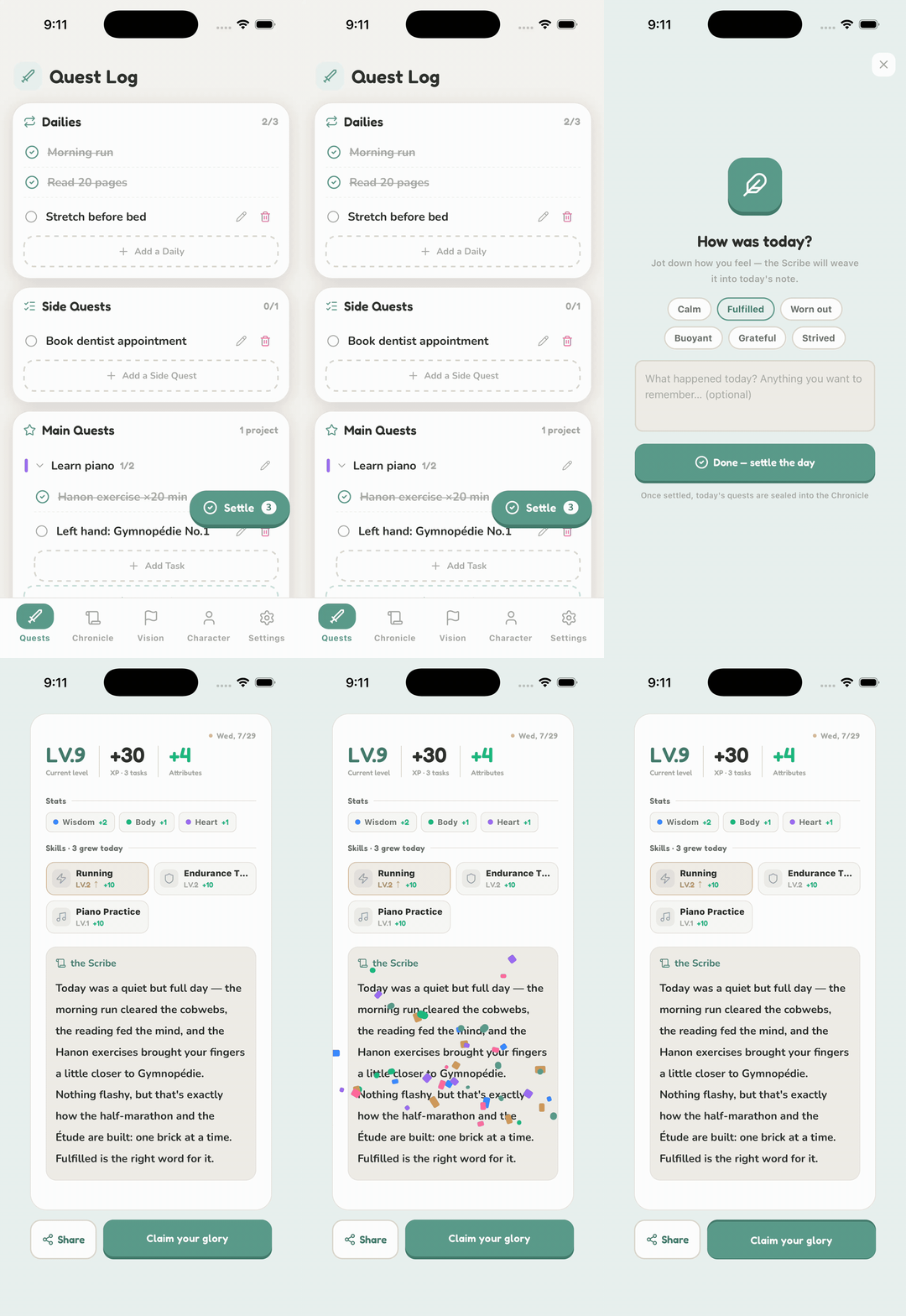
That’s the pitch. Now the confession.
The “I shipped an app in a day” tweets are true. I know because Hotari’s prototype took me about an hour, one evening last year. The core loop, typing in your day and reading what the AI saw in it, worked on the first try. My wife laughed out loud at its take on her day. I went to bed feeling like a genius.
Then it sat for almost a year.
I didn’t abandon it. I wired the prototype into an agent setup with OpenClaw so it could run on its own, and used that to answer the only question that mattered: does “an AI narrates your day and scores your life like an RPG” still feel good in week two, or is it a toy you show people once? It held up. The daily ritual of settling my day and reading what the AI saw in it kept pulling me back.
So this May I started building it for real. Eleven weeks later, it’s a product: hotari.app. This post is about what those eleven weeks were actually for, because that’s the part the ship-in-a-day discourse skips.
The numbers were lying
Early on, a day of normal life would earn you +60 stat points. Felt amazing. Meant nothing.
Worse: “fed the baby lunch” and “solo-parented an entire Saturday” both scored +3. If your numbers can’t tell those two days apart, they aren’t a mirror, they’re confetti. I rewrote the scoring rubric with anchored difficulty tiers. A good day now moves you about +12, and leveling slowed down with it.
Nerfing your own product is a strange feeling. But a growth tracker that flatters you is just a slot machine with extra steps.
The AI had to learn to say no
Hotari has skill fusion: your “running” and “swimming” skills can fuse into “endurance training.” The early version would fuse anything. Programming plus cooking? Sure, here’s some cool-sounding nonsense with a mystical name.
Now the fusion AI (the app calls it the Forgemaster) refuses. If two skills have no real overlap, it tells you the forge won’t take them, and suggests where to look instead. Watching an AI decline to flatter you turned out to be one of the most trust-building moments in the app. That took prompt work, adversarial review, and a redesigned failure ceremony in the UI. A demo never has to say no.
The design was wrong
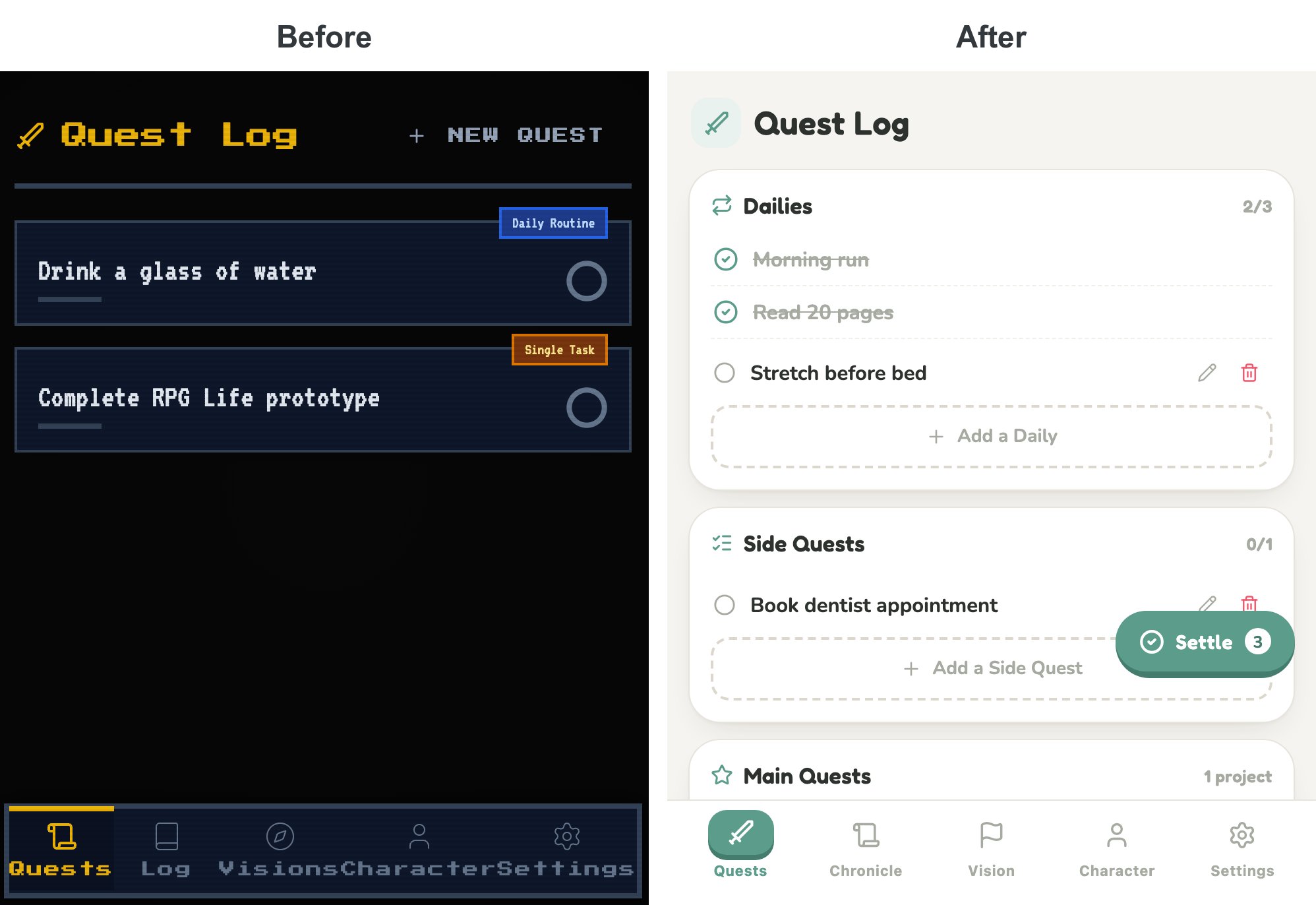
Version one had pixel fonts and a CRT scanline shader, because life RPG means retro pixels, right?
Wrong audience. The people this app is for are tired strivers who can’t see their own progress. They need a warm mirror, not an arcade cabinet. I threw out the whole visual identity mid-project and rebuilt it soft and quiet: rounded type, low-saturation themes, gentle motion. The before/after screenshots are almost funny.
My favorite feature died in front of me
I watched my wife use the app for two weeks, unprompted. The AI narrative, the thing that made her laugh on day one, decayed into something she skimmed. What kept her coming back was duller and deeper: a radar chart showing which part of her life had quietly gone dark lately.
That observation rearranged my roadmap. It deserves its own post, so I’ll just leave the shape of it here: the feature that demos best and the feature that retains people are not necessarily the same feature.
And everything else
Four languages (English, Simplified and Traditional Chinese, Japanese) with parity tests so no key drifts. Thirty database migrations. Rate limiting and a security review, because the internet is hostile. Payments, a trial that doesn’t ask for a card, legal pages in four languages. A local cache so a three-year-old phone doesn’t choke on your history. Just under 800 tests.
Oh, and I renamed the app twice, because both previous names turned out to be taken by other apps in the same niche. That one’s getting its own post too.
The part where I admit the AI wrote most of it
Final tally: 1,300 commits across 58 working days. 49 design specs. 83 implementation plans. About 30,000 lines of TypeScript before tests.
AI wrote most of those lines. I’m not going to pretend otherwise, and I don’t think it’s a confession. My job was everything around the lines: writing specs, arguing with review agents, rejecting designs, watching a real user, deciding what the numbers should mean.
So here’s where I’ve landed on the whole discourse: AI did not compress product-making into a day. It compressed a team into one person. The hour gets you the demo. The eleven weeks are for all the decisions the demo lets you postpone.
Why this thing exists
Real life gives you feedback on a five-year delay. You grind for months with no evidence any of it is adding up, and in that gap, I kept quitting on myself. You’re leveling up. You just can’t see it. Hotari is the mirror.
A few details I didn’t cover above: the Scribe has eight voices, from a warm mentor to a roaster who makes fun of you. You can set long-term visions, and a Seer sketches the future self they point at. And there are no streaks and no guilt mechanics anywhere. Miss a week and the app doesn’t scold you; the Scribe just picks your story back up.
Seven days free, no card: hotari.app. If something breaks or the Scribe says something dumb, tell me. I read everything.